

Vetiver (khus)
“Damp earth, dry wood and a curl of smoke. Cool, even in summer.”
Read more: en.wikipedia.org
Vetiver: The Fragrance of Earth, and Why No Two Roots Smell Alike
There are certain ingredients in perfumery that seem to carry the memory of the earth within them, and Vetiver is perhaps the most beautiful example. Botanically known as Chrysopogon zizanioides, formerly Vetiveria zizanioides, this extraordinary aromatic grass belongs to the Poaceae family. Unlike most fragrant grasses, where the leaves provide the essential oil, Vetiver hides its aromatic treasure beneath the ground, within an extensive network of roots. To my nose, a beautiful Vetiver can smell of damp soil, freshly cut roots, dry timber, bitter grapefruit peel, smoke, minerals and sometimes a surprisingly delicate floral sweetness. It is simultaneously rugged and elegant, possessing a darkness that never necessarily becomes heavy. What fascinates me is that Vetiver can communicate both moisture and dryness, as though the same root remembers the monsoon and the summer that followed it.
Vetiver originated in Asia, with India holding a particularly important place in its botanical and cultural history. Known as Khus, the fragrant roots have been traditionally used in cooling screens, mats and aromatic preparations. Today, important perfumery sources include Haiti, India, Indonesia, particularly Java, and Réunion Island, historically known as Bourbon. Haiti produces some of the most admired commercial Vetiver oils, frequently possessing a beautiful balance between dry earthiness, soft woodiness and an elegant grapefruit-like freshness. Java Vetiver often expresses a darker, smokier, more leathery and intensely earthy personality. Indian Khus can possess an extraordinary rooty, balsamic and earthy richness, although its character varies considerably according to origin and preparation.
Bourbon Vetiver from Réunion is historically celebrated for its refined, softly woody and sometimes rosier qualities. Additional oils are produced in countries including Madagascar, Brazil and China. These geographical descriptions are tendencies, not rigid quality classifications. A well-distilled Java Vetiver may be considerably more beautiful for a particular composition than an expensive oil from a traditionally prestigious origin.
What makes Vetiver chemically extraordinary is the complexity of its essential oil. Steam distillation of the roots produces a remarkably intricate mixture of sesquiterpenes and oxygenated compounds. Important constituents include khusimol, vetiselinenol, various vetivenes and vetispirenes, together with numerous other molecules that influence its aromatic personality. Vetivone-related ketones also contribute to the characteristic woody-earthy profile. I find it particularly interesting that the smell of Vetiver cannot be reproduced convincingly by selecting only its most abundant constituents. The distinctive grapefruit-like, woody and mineral impressions depend upon a much more complicated arrangement of odorants.
The age of the roots, soil, harvesting conditions, drying, distillation duration and subsequent processing can all influence the character of the oil. Some producers further refine or fractionate Vetiver to reduce harsh smoky or earthy notes, producing cleaner materials suitable for contemporary perfumery. But I personally find that excessive refinement can sometimes remove precisely the imperfections that make a natural material extraordinary.
In my laboratory, I approach Vetiver as several different artistic instruments rather than one universal woody ingredient. Haitian Vetiver is particularly compelling when I want sophisticated dryness beneath citrus, iris, rose or transparent woods. Java Vetiver interests me for darker compositions involving leather, tobacco, patchouli, guaiacwood and incense. Indian Khus offers a fascinating direction for earthy, root-driven fragrances, particularly when I want to capture the atmosphere of damp vegetation and monsoon soil. Bourbon-style Vetiver can be magnificent in elegant woody florals. I am especially fascinated by its relationship with grapefruit, bergamot, black pepper, frankincense and orris.
In the right proportion, Vetiver can introduce remarkable depth without requiring excessive amber or sweetness. It can also contribute substantivity, but its presence should not be mistaken for a universal guarantee of projection or longevity. I prefer studying several origins side by side at identical dilutions, because their differences become particularly instructive when the concentration and evaluation conditions are consistent.
My affection for Vetiver comes from its ability to evoke landscapes rather than merely individual smells. A beautiful Vetiver does not simply remind me of a root. It can suggest an entire forest floor, the warmth of dry earth, old timber, rain-soaked vegetation or the strange mineral freshness that emerges when the first rain touches the ground. The Western Ghats and the Konkan landscape have made me particularly attentive to these contrasts. I would encourage every fragrance enthusiast to compare authentic Haitian, Java, Indian and Bourbon Vetiver before deciding which one is the finest. You may discover that each possesses a beauty the others cannot reproduce. Some ingredients teach a perfumer how flowers bloom.
Vetiver teaches us how the earth breathes. And perhaps that is why I find it so magnificent: it possesses no need to imitate beauty above the ground, because everything extraordinary about it has been growing quietly beneath our feet.
Artisan Dixit · Perfumer & Founder, Perito Moreno
Perfumes with vetiver (khus)
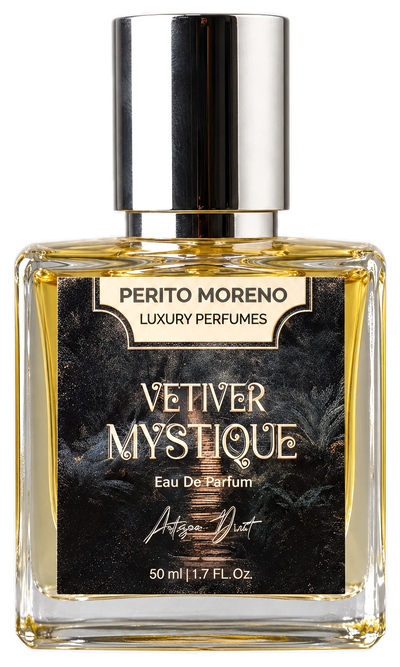
Vetiver Mystique
A ’70s blazer, a turtleneck, smoky vetiver.

Silver Coast
First light on the coast. Cool and airy.

Vetiver Jacmel
Haitian vetiver from 2017, aged five years.