Ginger grass
“Green and grassy, with a rosy heart and a peppery kick.”
Ginger Grass: The Wild Indian Grass That Hides a Rose Beneath Its Spices
There are certain aromatic materials that possess an immediately recognisable beauty, and then there are materials that seem almost deliberately determined to confuse the perfumer. Ginger Grass belongs rather magnificently to the second category. It is one of those ingredients that I believe deserves far greater attention than it receives in contemporary perfumery, particularly because its character is so frequently misunderstood. Botanically associated with Cymbopogon martinii var. sofia, Ginger Grass belongs to the same species complex as Palmarosa, yet its aromatic identity can be remarkably different. Despite its name, Ginger Grass is not obtained from ginger root, Zingiber officinale, nor should it be expected to reproduce the familiar juicy, peppery warmth of freshly crushed ginger.
Its fragrance is considerably stranger and, to my nose, far more difficult to classify. Imagine the green sharpness of crushed wild grass, the dry aromatic character of herbs, a faintly peppery warmth and an unusual rosy sweetness emerging from beneath a more rugged botanical exterior. There can be something slightly turpentine-like, almost resinous, in certain qualities, accompanied by a refreshing citrus-like brightness and an unexpected woody dryness. Some samples reveal a pronounced geranium-like floral character, while others possess a greener, more camphoraceous and distinctly less floral personality. What fascinates me is the contrast between this material and Palmarosa.
Palmarosa often possesses an immediately attractive, rounded, rosy fragrance, largely associated with its high geraniol content. Ginger Grass is generally more unruly. Its floral aspect can be interrupted by sharper terpenic, grassy and spicy nuances that make it considerably less predictable. Depending upon the chemotype, constituents such as geraniol, geranyl acetate, limonene, carveol, piperitol and related monoterpenes may contribute to the oil's character. Their proportions are not constant across all commercial samples. This is precisely why I believe a natural ingredient should never be judged solely by the name printed on its bottle. To me, Ginger Grass resembles a rose growing wild in the middle of a field of aromatic grasses, beautiful certainly, but unwilling to surrender the earthy and slightly rough personality of the landscape surrounding it.
It is not an ingredient that has been carefully dressed for a formal occasion. It arrives carrying the smell of vegetation, sun-warmed stems and something almost rebellious beneath its delicate floral softness. And I find that enormously attractive.
The history of Ginger Grass is particularly interesting because it belongs to India's own aromatic heritage, yet has remained considerably less celebrated than many other essential oils originating from the same botanical family. The genus Cymbopogon has given perfumery several extraordinarily important materials, including lemongrass, citronella, Palmarosa and Ginger Grass. These plants have played significant roles in the cultivation and distillation of aromatic grasses across India and other tropical regions. Ginger Grass, traditionally associated with the Sofia variety, has been collected from wild-growing populations and cultivated for its essential oil.
Historical botanical and commercial literature distinguished it from the more commercially valuable Motia variety, whose geraniol-rich oil became widely recognised as Palmarosa. I find this distinction particularly fascinating because it reveals something about the way the fragrance industry assigns value to natural ingredients. Palmarosa developed a strong commercial reputation partly because of its pleasant rosy odour and its usefulness as a source of geraniol. Ginger Grass, with its more complicated and sometimes less immediately agreeable aromatic profile, received comparatively less attention. Yet I have never believed that commercial popularity is a reliable measure of artistic potential.
In fact, the materials that fail to fit comfortably into established industrial requirements are often the ones that interest me most. The history of Indian essential-oil production demonstrates how botanical selection, cultivation and distillation can influence the aromatic identity of these grasses. Ginger Grass oil is obtained primarily through steam distillation of the aerial portions of the plant, including its flowering material. The maturity of the grass, harvesting conditions, geographical origin and distillation procedure can all affect the resulting composition. As a chemical engineer, I find this relationship between botanical development and extraction particularly compelling.
Steam distillation does not simply transfer the complete smell of a living plant into a bottle. It selectively recovers volatile constituents, and the final oil reflects the interactions between temperature, water, plant tissue and the chemical stability of the aromatic molecules. Different populations of Ginger Grass can display substantial compositional differences, making analytical evaluation especially important. An oil from one growing region may possess a prominent rosy character, while another may be considerably greener, sharper or more terpenic. I would therefore never assume that every bottle labelled Ginger Grass represents the same olfactory experience.
Its Indian origin is culturally meaningful to me, but its scientific individuality is what makes it truly fascinating.
When I examine the place of Ginger Grass within the history of fine fragrance, I find that its most interesting story is not one of glamorous perfume launches or famous bottles carrying its name. It is the quieter history of Indian aromatic grasses contributing to the development of modern perfumery. During the expansion of the essential-oil industry, materials such as Palmarosa, lemongrass and citronella became valuable because they provided perfumers and aroma chemists with useful aromatic compounds and relatively accessible natural fragrance materials. Ginger Grass belonged to this broader tradition, although its more variable composition and less conventional character limited its commercial prominence.
Technical perfumery literature, including historical sensory and chemical evaluations of tropical grass oils, recognised Ginger Grass as a distinct material rather than merely an inferior Palmarosa. I find that distinction important. A material may be less suitable for producing a predictable, geraniol-rich floral oil and still possess remarkable artistic value in an original perfume composition. The wider history of aromatic perfumery provides several beautiful contexts in which I believe Ginger Grass deserves exploration. Classical fougères brought together lavender, aromatic herbs, floral materials, coumarin and mossy foundations to create an extraordinarily sophisticated relationship between freshness and warmth.
Traditional green chypres explored sharper botanical bitterness against floral and earthy structures. Ginger Grass can contribute to these olfactory ideas through its grassy, aromatic and subtly floral character, although I would not invent its presence in the proprietary formulas of historical fragrances. Its relationship with rose is particularly interesting because some aspects of its aroma can reinforce rosy freshness while introducing botanical roughness that a conventional rose accord might lack. In a geranium-led composition, Ginger Grass may contribute an unusual bridge between the floral and aromatic elements. And in contemporary woody fragrances, its drier, spicier aspects may offer a way of creating natural freshness without relying exclusively upon citrus or sharp synthetic green notes.
What I admire most is the possibility of giving this relatively overlooked Indian essential oil a more deliberate artistic identity. Rather than treating it as a cheap alternative to a more famous material, I would prefer to examine what it can accomplish that Palmarosa itself cannot. The difference between these two approaches is fundamental. One sees Ginger Grass as an imperfect substitute. The other sees it as an individual botanical material whose unusual qualities may lead to a completely different kind of beauty.
In my own approach to perfumery, Ginger Grass interests me precisely because of the tension between its floral softness and its slightly wild, aromatic personality. I am not particularly interested in using it simply to make a formula smell rosy. For that purpose, there are numerous natural and synthetic materials capable of producing beautiful results. What attracts me is the possibility of using Ginger Grass to introduce something less predictable into an otherwise refined composition. I am particularly interested in its relationship with rose, where a carefully measured quantity can potentially contribute green, spicy and botanical nuances beneath the familiar floral character.
A beautiful rose accord should not always smell like perfect petals arranged inside an expensive vase. Sometimes I want it to possess the fragrance of leaves, stems and the surrounding vegetation. Ginger Grass offers an interesting direction for that kind of realism. Geranium is another natural companion, especially when I wish to explore the relationship between rosy floral character, herbal freshness and slightly minty aromatic facets. Palmarosa itself makes an excellent comparative material, not necessarily because I want to use both in every formula, but because the contrast between their chemical and aromatic personalities can be enormously instructive.
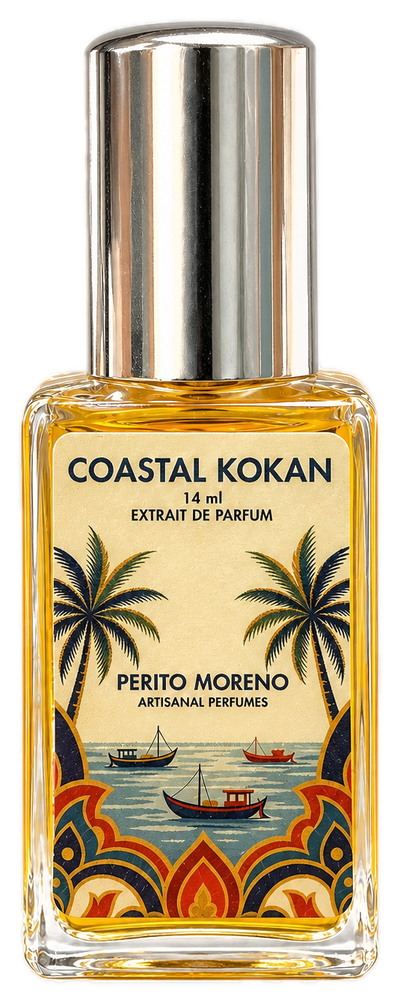
In a fresh aromatic composition, I would examine Ginger Grass alongside bergamot, lime, petitgrain, lavender and clary sage, carefully observing whether its grassiness contributes a natural transition or makes the opening excessively sharp. Cardamom and black pepper offer another interesting direction. Their spicy aromatic personalities may reinforce the drier aspects of Ginger Grass while introducing contrasting forms of freshness. I am particularly fascinated by the possibility of using Ginger Grass in compositions inspired by India's western coastline and the landscapes of Konkan. I have always felt that the smell of tropical vegetation is considerably more complex than the generic green accords we frequently encounter in commercial fragrances.
There is the warmth of sun-exposed grass, the sharp aroma released when stems are crushed, the lingering moisture of the monsoon and the peculiar way botanical sweetness emerges from an otherwise rugged landscape. Ginger Grass belongs beautifully within this artistic conversation. In woody compositions, I would explore its relationship with vetiver, cedarwood, sandalwood and patchouli, particularly when I want greenery that feels dry and aromatic rather than watery. It also presents interesting possibilities with frankincense and elemi, where its terpenic character may create continuity between aromatic freshness and resinous warmth. However, the actual oil must be studied carefully before any artistic decision is made.
A geraniol-rich batch will behave quite differently from a material dominated by other monoterpenes, and the perfumer must work with the character of the ingredient actually present rather than with an idealised catalogue description. I prefer controlled dilutions, side-by-side evaluations and careful observation over time. Natural Ginger Grass oil also requires appropriate compositional analysis, oxidation control and safety assessment, particularly because constituents such as geraniol may be relevant to fragrance allergen declarations and restrictions. The objective is not merely to introduce an unusual Indian botanical name into a formula. It is to understand what this material can contribute through its own aromatic personality.
And I believe that is where genuine artisanal perfumery begins.
My personal fascination with Ginger Grass is connected to something that has gradually become central to my philosophy as a perfumer: nature does not always create its most interesting smells for the convenience of the fragrance industry. Some plants yield magnificent, commercially predictable oils, while others produce materials whose personalities vary, whose qualities are difficult to classify and whose usefulness may not be immediately apparent. I have always been particularly drawn towards the latter. Ginger Grass is a wonderful example because it invites us to reconsider what we mean when we describe an ingredient as beautiful. Palmarosa possesses an elegance that is relatively easy to appreciate.
Its rosy softness makes it a natural companion to many floral compositions. Ginger Grass is more complicated. It can possess an appealing floral character, but that beauty is interrupted by grassy bitterness, aromatic sharpness and an almost unruly botanical freshness. I find these interruptions extraordinarily valuable. They remind me that a living plant does not smell like a perfectly constructed perfume accord. It contains contrasts, unexpected materials and occasionally aspects that are not conventionally pleasant when examined in isolation. But those very imperfections can make a fragrance feel more believable. I would encourage every serious student of perfumery to obtain authenticated samples of Ginger Grass and Palmarosa and evaluate them side by side.
Begin with carefully prepared dilutions and smell them without allowing their commercial reputations to influence your judgement. Observe the rounded rosy sweetness of Palmarosa, then examine the sharper, greener and more complex character that Ginger Grass may reveal. Return to the samples after the initial bright notes have softened. Compare them with geranium, rose, cardamom, vetiver and a simple green accord. You may discover that the supposedly less refined material possesses precisely the kind of individuality that an original composition requires. My affection for the aromatic plants of India, particularly those associated with the Western Ghats and the Konkan landscape, has taught me to look beyond the familiar hierarchy of expensive and inexpensive ingredients.
I am not interested in using a material because it happens to be rare, nor am I willing to dismiss one because it is relatively accessible. I want to understand the beauty that exists within it. Ginger Grass represents this philosophy rather magnificently. It is a plant whose aromatic character exists somewhere between flower, grass, spice and wood, unwilling to surrender completely to any one of them. To me, Ginger Grass is a reminder that nature does not produce inferior versions of beautiful smells. It produces different personalities. Some are polished and immediately charming, while others are wild, complicated and considerably more difficult to understand.
And very often, it is the difficult ones that teach a perfumer something genuinely new.
Artisan Dixit · Perfumer & Founder, Perito Moreno