Bhui chafa
“The ghost flower. It blooms from bare earth before the rain.”
Bhui Chafa: A Forgotten Flower from the Soil of Konkan, and My Attempt to Give It a Place in Perfumery
There are certain flowers that the world has celebrated for centuries, and then there are flowers that seem perfectly content to remain hidden, almost as though they have no desire whatsoever to be discovered. Bhui Chafa belongs to the latter category, and perhaps this is precisely why I became so fascinated with it. Botanically known as Kaempferia rotunda, Bhui Chafa is a remarkable flowering plant belonging to the ginger family, Zingiberaceae. Unlike the familiar champaca flowers that grow upon trees, Bhui Chafa produces its extraordinary blossoms remarkably close to the earth, often before the plant's leaves have fully emerged. Its flowers possess delicate white and violet colouring, an almost improbable elegance for something appearing so close to the soil.
The name itself is wonderfully descriptive. In Marathi, Bhui refers to the ground, and Chafa evokes the familiar world of fragrant champa-like flowers. Yet Bhui Chafa is not simply another variety of the conventional champaca. It belongs to an entirely different botanical family, and that distinction is important to me. I have always believed that the character of a flower should be understood through the flower itself rather than through the expectations created by its name. There is something profoundly beautiful about a fragrant blossom emerging directly from the earth, announcing itself without the assistance of a towering tree or an extravagant display of foliage.
It is almost the opposite of what we have come to expect from luxury perfumery. No cultivated glamour, no established reputation, no celebrated French perfume bearing its name. Just a small, extraordinary botanical creation whose fragrance deserves to be understood on its own terms. I find this infinitely more exciting than being presented with yet another expensive ingredient whose reputation has already been carefully constructed by the fragrance industry. Bhui Chafa represents a different kind of beauty to me. The beauty of something that existed long before anyone thought of putting it inside a perfume bottle.
My fascination with Bhui Chafa is inseparable from my almost unreasonable affection for the Konkan region of Maharashtra. I have always felt that Konkan possesses an aromatic identity that Indian perfumery has barely begun to explore. People usually describe the region through its beaches, coconut trees, Alphonso mangoes and magnificent monsoon landscapes. All of that is beautiful, certainly, but I believe the real personality of Konkan exists in the countless smaller smells that rarely find their way into travel descriptions. There is the peculiar dampness of laterite soil after heavy rain, the green bitterness of crushed vegetation, the mineral character of wet stone, the salt carried by coastal winds, and the complicated fragrance of wild plants growing without anyone's permission.
The Western Ghats and the coastal belt create a botanical environment that I find endlessly captivating. Every time I think about the region, I am reminded that a landscape is not merely something we see. It is something we smell, often without realising how deeply those smells become attached to our memories. My interest in Bhui Chafa grew out of this larger obsession with the aromatic possibilities of Konkan. I did not want to recreate the region using the usual collection of marine molecules, tropical fruits and commercially familiar flowers. I wanted to explore materials that belonged to its botanical vocabulary, including those that had received little attention from modern fine perfumery.
Bhui Chafa became one of the most compelling subjects of that exploration. Unlike rose, jasmine, tuberose or conventional champaca, it did not arrive with an established perfume tradition telling me how it should be used. There was no celebrated fragrance from the past that I needed to imitate, nor a familiar commercial extract against which I could conveniently measure success. I was interested in the possibility of bringing a lesser-known Indian flower into the language of contemporary artistic perfumery. My attachment to Konkan has never been merely geographical. It is an attachment to its atmosphere, its botanical individuality and the extraordinary beauty of things that remain largely unnoticed.
Bhui Chafa allowed me to express that attachment through the one language I understand most intimately: fragrance.
What makes this particular exploration so interesting is that Bhui Chafa has a botanical and cultural history, but not an established history as a recognised fine-perfumery flower. The plant has been documented in Indian botanical literature and is known by several regional names, including Bhuichampa and Bhumichampaka. Its rhizomes have attracted scientific interest, and researchers have investigated their volatile constituents using analytical techniques such as gas chromatography and mass spectrometry. But the chemical investigation of a plant's underground rhizome is not the same thing as the artistic development of its flower fragrance. These are two entirely different aromatic questions.
The rhizome belongs to the botanical world of ginger-like underground structures, whereas the flower possesses its own fragrance-producing tissues and potentially a very different volatile profile. I find it essential to respect that distinction. One cannot simply extract an aromatic material from the underground portion of a plant and assume that it represents the smell of its blossoms. My interest was in exploring Bhui Chafa as a floral identity, not merely borrowing its beautiful name for an unrelated composition. This is where my background in chemical engineering becomes particularly useful. Understanding a flower is not simply about recognising that it smells pleasant.
It requires asking which volatile compounds create its character, how their proportions change, which extraction techniques might preserve the desired aroma, and whether the resulting material can be made consistent enough for meaningful use in perfumery. Some flowers surrender their fragrance rather generously to extraction. Others prove remarkably difficult, particularly when their most beautiful volatile constituents are delicate, present in small quantities or altered by processing. I have always believed that the challenge of a difficult botanical material is part of its artistic appeal. If every flower could be transformed into a magnificent absolute through a simple commercial procedure, perfumery would be a considerably less interesting profession.
With Bhui Chafa, my ambition was to investigate a floral subject that had not been established within the conventional perfumer's palette, and to find a way of giving that subject a meaningful place in my work. I regard that as an original creative undertaking rather than a claim that nobody before me had ever studied the plant. Scientific curiosity and artistic curiosity sometimes arrive at the same botanical specimen for entirely different reasons. The scientist may wish to understand what the plant contains. I wish to understand what the plant can become.
When I began thinking about how Bhui Chafa might belong within a perfume, I knew that I did not want to turn it into an exaggerated tropical floral simply because it came from a region associated with abundant vegetation and warm coastal weather. Konkan, to me, is considerably more sophisticated than a conventional tropical fragrance advertisement. Its beauty lies in contrast. The brightness of coastal sunlight against the darkness of monsoon clouds. The freshness of rain against the warmth of laterite stone. The sweetness of flowering plants against the faint bitterness of surrounding leaves. It was this relationship between different aromatic impressions that guided my creative thinking.
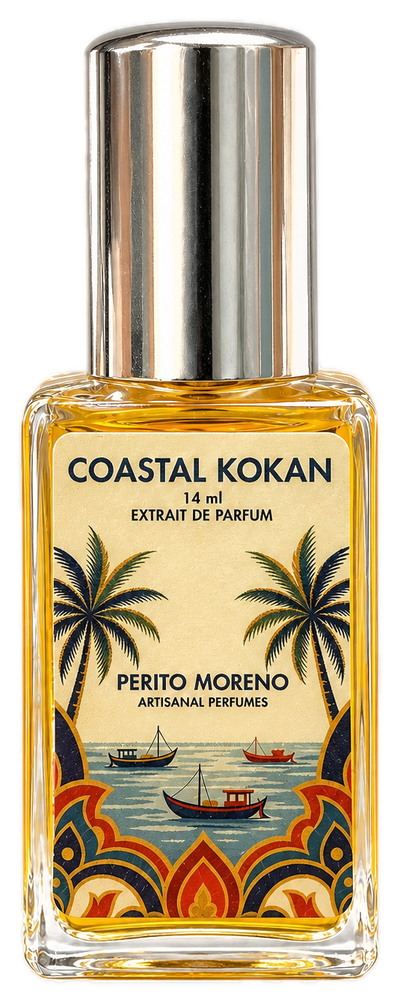
In my composition Coastal Kokan, Bhui Chafa found its place within a wider interpretation of the region, surrounded by the brightness of bergamot and lemon, the saline impression of sea air, the floral richness of ylang-ylang and jasmine, and the distinctive warmth of clove and ginger grass. Bakula bark, musk and sandalwood contribute additional dimensions to that aromatic landscape. What matters to me is not simply the presence of Bhui Chafa in the note structure, but the decision to give a less familiar regional flower a place alongside ingredients that perfumers have used for generations. This is something I have always wanted to achieve through Perito Moreno.
I do not believe Indian perfumery must restrict itself to sandalwood, oud, rose, jasmine and the familiar collection of spices that international audiences have come to associate with our country. India possesses an extraordinary diversity of botanical materials, many of which remain insufficiently explored as subjects for fine fragrance. My approach is to understand these materials individually and then place them within carefully considered compositions where they can contribute something artistically meaningful. A regional flower should not appear in a perfume merely to make the ingredient list sound unusual. It should have a reason to exist within the fragrance.
With Bhui Chafa, that reason is deeply personal. It represents my desire to capture a part of Konkan that cannot be purchased through a conventional fragrance catalogue. It is my way of acknowledging that the landscape which inspires a perfume can also contribute its own botanical voice to the finished creation.
There is something especially satisfying about working with a material for which there are no established rules, and I believe Bhui Chafa represents one of the more meaningful directions of my journey as an artisan perfumer. I have spent years studying traditional ingredients, examining their chemistry, understanding their extraction processes and learning from the extraordinary work of perfumers who came before me. I have enormous respect for that inheritance. But I have never wanted my entire career to consist of rearranging the same familiar materials into slightly different compositions. The more time I spend with natural ingredients, the more convinced I become that some of the most exciting possibilities in perfumery remain outside the established commercial supply chain.
They may be growing in remote landscapes, appearing for only a short flowering season, or existing within botanical traditions that have never been seriously examined from an olfactory perspective. My obsession with Konkan comes from precisely this belief. I do not see the region merely as an inspiration for a pleasant coastal perfume. I see it as an extraordinary botanical landscape whose aromatic character deserves much deeper investigation. Bhui Chafa has become a symbol of that philosophy for me. I am not particularly interested in declaring that I have discovered a flower which nature and local communities have known for generations. That would be a rather absurd way of describing the work.
What excites me is the possibility of introducing its identity into my own language of perfumery and making room for a flower that has rarely been part of the conventional fine-fragrance conversation. To those who encounter Bhui Chafa through my compositions, I would encourage you to appreciate it without expecting it to behave like the familiar flowers you already know. Its importance to me is not founded upon extravagant claims of rarity, nor upon an attempt to create artificial exclusivity. It comes from curiosity, from affection for a particular landscape, and from a conviction that meaningful originality begins when we become willing to explore what others have overlooked.
Perhaps the most beautiful thing about Bhui Chafa is that it reminds me why I became a perfumer in the first place. Not to manufacture an expensive smell, but to pursue the extraordinary relationship between nature, chemistry and human emotion. The world may know Konkan for its sea, its monsoons and its magnificent mangoes. I know it as a place with thousands of aromatic stories still waiting to be told. Bhui Chafa is one of the stories I chose to tell through perfume. And if my work can give even one forgotten flower a voice beyond the soil from which it rises, I would consider that a rather beautiful achievement.
Artisan Dixit · Perfumer & Founder, Perito Moreno
“It comes up out of dry ground before the monsoon, with no leaves at all. In Coastal Kokan it is the moment the perfume stops being a beach and becomes a temple.”