

Frankincense (olibanum)
“Cool church smoke with a bright, peppery, almost citrus lift.”
Read more: en.wikipedia.org
Frankincense: The Tears of Ancient Trees and the Extraordinary Personalities of Olibanum
There are certain aromatic materials that I believe deserve to be approached with almost religious patience, not necessarily because of their spiritual associations, but because their complexity is far greater than what most people imagine. Frankincense is undoubtedly one of them. Also known as Olibanum, frankincense is obtained from trees belonging to the genus Boswellia, and I have always found it rather unfortunate that perfumers frequently describe the material with one convenient word: incense. To my nose, frankincense is not simply the smell of a temple, a church or a burning resin. A beautiful natural frankincense can possess the sparkling brightness of lemon peel, the green freshness of pine needles, an almost peppery sharpness, a subtle mineral dryness, delicate balsamic warmth and, occasionally, an extraordinarily elegant sweetness that seems to appear from nowhere.
Some varieties possess an almost crystalline freshness, while others feel warmer, softer, fruitier or considerably darker. The most fascinating thing is that frankincense is not one botanical material. Omani Frankincense, obtained from Boswellia sacra, can express a magnificent citrus-terpenic brightness, particularly in carefully selected grades. Somali Frankincense, commonly traded as Boswellia carterii or B. carteri, often possesses a beautiful relationship between resinous freshness, delicate citrus and woody warmth, although the taxonomic relationship between B. carterii and B. sacra remains a subject of scientific discussion. Indian Frankincense, Boswellia serrata, also known as Salai or Salai Guggul, frequently introduces a more assertive terpenic, herbal and sometimes peppery personality.
Ethiopian and Sudanese Frankincense, particularly Boswellia papyrifera, can possess a remarkably different character, often softer, sweeter and more rounded, with a distinctive fruity-balsamic quality associated with its characteristic octyl acetate content. Then there is Boswellia frereana from Somalia, traditionally known as Maydi, whose aromatic personality can be beautifully warm, sweet, resinous and comparatively gentle. More unusual species, including Boswellia neglecta and Boswellia rivae, expand this already fascinating vocabulary into darker, more earthy, woody and occasionally unusual balsamic territories. These descriptions are tendencies rather than universal guarantees, because differences between individual trees, harvests, grades and distillation processes can be enormous.
To me, studying frankincense is rather like studying an entire family of extraordinarily talented musicians. They may all belong to the same orchestra, but they certainly do not play the same instrument. Some sing with the brightness of citrus, some speak with the warmth of wood, and others possess a quiet resinous darkness that seems almost impossible to describe. Frankincense is not merely incense. It is one of nature's most sophisticated conversations between freshness, resin and time.
The history of frankincense is so extraordinary that I sometimes find it difficult to believe we now encounter the material in ordinary commercial bottles. For thousands of years, aromatic resins obtained from Boswellia trees travelled through ancient trade routes connecting southern Arabia, the Horn of Africa, the Mediterranean, India and numerous other regions. Frankincense became an important commodity in ceremonial traditions, incense preparations, medicine and early forms of fragrance. The ancient incense trade contributed enormously to the prosperity of trading centres in southern Arabia, particularly the region that includes present-day Oman and Yemen.
The resin was valued across several religious and cultural traditions, and its fragrant smoke became associated with sacred spaces, royal ceremonies and the experience of purification. Yet I find the botanical story considerably more interesting than the grandeur surrounding the historical trade. Frankincense trees often grow in remarkably difficult environments, including arid landscapes, rocky slopes and regions where water is scarce. They are not the magnificent, towering trees people commonly imagine when thinking about valuable aromatic materials. Some possess twisted trunks and appear almost impossibly attached to bare rock. To obtain the resin, carefully controlled incisions are made in the bark, allowing a milky exudate to emerge and eventually harden into the familiar aromatic tears.
The resin is collected after a period of drying, and its appearance, colour, size and quality can influence its commercial classification. In Oman, grades such as Hojari have acquired considerable recognition, but a commercial grade should not be confused with a separate botanical species. This is a distinction I consider particularly important. I have seen how easily the fragrance industry becomes fascinated by attractive names while overlooking the actual science of the material. From my perspective as a chemical engineer, the most interesting part begins when we examine what happens inside these resin tears. Frankincense is an oleo-gum-resin containing volatile aromatic compounds, resinous constituents and water-soluble gum components.
Its essential oil is largely composed of volatile terpenes, while heavier resinous compounds, including boswellic acids in certain species, are not recovered in meaningful quantities through ordinary steam distillation because of their low volatility. Consequently, the smell of burning natural frankincense, the aroma of its steam-distilled oil and the character of a suitable resin extract can be remarkably different. When the resin is burned, heat creates additional aromatic transformations. When it is distilled, we obtain a selected volatile fraction. When it is extracted using other methods, different aromatic and resinous components may be retained.
These are not interchangeable expressions. I have always believed that understanding this distinction is essential before attempting to use frankincense intelligently. The history may tell us why humanity valued it. The chemistry tells us why the material is so endlessly fascinating to a perfumer.
When I study the historical development of frankincense within fine fragrance, I am particularly interested in how its identity gradually moved beyond ceremonial smoke and became a sophisticated element of modern perfume architecture. Incense and resinous materials formed part of aromatic preparations long before the development of contemporary fine fragrance, but the characteristic smell of modern incense perfumes is frequently constructed through several materials rather than frankincense alone. One important contemporary reference is Comme des Garçons Series 3 Incense, introduced in 2002, particularly Avignon, which explores the atmosphere of ceremonial incense with remarkable conviction.
What fascinates me is that the perfume does not simply attempt to reproduce the smell of an essential oil. It constructs an entire environment, a sensation of smoke, cool stone, resinous warmth and the lingering atmosphere of a sacred building. Another beautiful reference is the work of the Omani perfume house Amouage, whose relationship with frankincense is particularly meaningful given the cultural and geographical importance of the material in Oman. Interlude Man, introduced in 2012, presents frankincense alongside amber, cistus and opoponax, creating a dense and dramatic resinous structure. What interests me here is the manner in which frankincense can provide aromatic movement within an otherwise heavy composition.
Its brighter terpenic aspects can create contrast against the deeper balsams, while the resinous character helps connect the different materials. But I would never assume that a listed frankincense note establishes which Boswellia species was used or whether a natural extract was employed at all. A perfumer can reconstruct an incense impression using several essential oils, resins and aroma molecules, and the resulting artistic expression may be considerably different from the smell of natural frankincense tears. What these fragrances demonstrate is the extraordinary range of possibilities within the incense family. Frankincense can become cold and mineral, warm and ambery, smoky and ceremonial, or surprisingly fresh and almost cologne-like.
I am especially interested in the latter interpretation because it challenges the conventional expectation that frankincense must always smell dark, ancient and religious. A beautiful Boswellia sacra essential oil can possess an extraordinary freshness that works wonderfully in contemporary aromatic perfumes. Boswellia papyrifera may contribute an entirely different rounded, almost fruity character, while Boswellia serrata can offer a more herbal, sharper aromatic direction. The historical importance of frankincense is undeniable, but I believe its future in artistic perfumery depends upon our willingness to appreciate the individual personality of each botanical species rather than treating all olibanum as one generic incense note.
In my own laboratory, frankincense is one of those materials I approach through several entirely different artistic directions because I find the idea of maintaining one universal frankincense accord rather limiting. The first question I ask is not how much frankincense a formula requires, but which aspect of its personality I want to explore. If I am building a luminous, fresh and almost mineral composition, I am particularly interested in the bright terpenic character associated with selected Boswellia sacra oils. The relationship between frankincense, bergamot, Buddha's Hand citron, bitter lemon peel and elemi can be extraordinarily beautiful.
Elemi, in particular, shares certain aromatic characteristics with frankincense while possessing its own peppery, lemony and resinous identity. Used intelligently, the combination can create a remarkable impression of light moving through a transparent resinous structure. In a darker composition, I become more interested in the relationship between frankincense, labdanum, benzoin, opoponax, styrax and selected woody materials. Here, the objective is not merely to make the perfume heavier. It is to create the impression of deep resinous warmth while preserving enough aromatic clarity to prevent the entire formula from becoming oppressive. I am particularly fascinated by frankincense in rose compositions.
A carefully measured amount can introduce an almost mineral austerity beneath the floral sweetness, making the rose feel more mature and considerably less decorative. Jasmine sambac presents another beautiful relationship, particularly when I want an indolic floral character to encounter the bright sharpness of incense. Orris is especially interesting because its powdery softness can create an extraordinary contrast against dry resinous materials. I also find frankincense valuable in leather and tobacco structures, particularly when the desired effect is an atmospheric dryness rather than overtly sweet balsamic richness. When examining different types, I would begin by comparing Boswellia sacra, B. carterii, B. serrata, B. papyrifera and B. frereana independently at controlled dilutions.
I would study their immediate brightness, the development of their woody and resinous qualities, and the differences that remain after the more volatile terpenes begin disappearing. I am particularly interested in the high-octyl-acetate character documented in many B. papyrifera oils, because it demonstrates how radically a frankincense oil can differ from the familiar alpha-pinene-rich profile. Equally, I would not assume that the presence of a particular constituent automatically makes one species superior to another. The finest grade depends upon what I am trying to create. In a fresh aromatic composition, I may value brightness and transparency.
In an amber, I may prefer warmth and depth. In a darker experimental fragrance, I may be searching for an unusual woody or resinous quality that a more conventional frankincense cannot provide. The choice of extract is just as important as the species. Steam-distilled oil, resin tincture and carefully prepared resinoid can contribute different aspects of the source material. I also believe that the responsible sourcing of frankincense deserves serious attention. Some Boswellia populations face pressure from overharvesting, poor regeneration, grazing, habitat degradation and environmental changes. Repeated tapping can damage vulnerable trees when harvesting is not managed appropriately.
For me, the beauty of a rare resin does not justify its irresponsible collection. A serious perfumer should understand not only how an ingredient smells, but also how it was obtained and whether the source population can continue producing it sustainably. I want my use of frankincense to express respect for the botanical material, the people who collect it and the extraordinary landscapes from which it comes.
My personal fascination with frankincense comes from the remarkable contradiction that exists within the material. People frequently associate it with solemnity, spirituality and the atmosphere of ancient ceremonial spaces, yet some of the finest frankincense oils possess a sparkling freshness that feels almost youthful. I find this duality extraordinary. A resin produced by a tree surviving in an arid, rocky landscape can smell unexpectedly bright, almost as though it has preserved the freshness of citrus inside itself. At the same time, when that resin is burned, the aromatic experience becomes deeper, warmer and considerably more atmospheric. It is difficult to think of another botanical material that can express such different personalities through changes in preparation.
I am particularly attached to Omani frankincense, not simply because of its celebrated historical reputation, but because I find the relationship between its botanical origin and its delicate aromatic character deeply compelling. When studying frankincense, I would encourage every serious fragrance enthusiast to abandon the idea that the material must smell like a temple or church. Obtain authenticated samples of Omani, Indian, Ethiopian or Sudanese, and Somali frankincense, and compare them carefully. Smell the raw tears where appropriate, then compare them with the corresponding essential oils. Observe how some possess an almost sparkling citrus-like opening, while others reveal a softer, fruitier or more resinous character.
If you have access to responsibly obtained material, examine Boswellia frereana and compare it with B. sacra. The differences can be particularly instructive. Then explore the oils alongside bergamot, rose, sandalwood, orris, labdanum and benzoin. You may discover that frankincense is capable of making a citrus accord feel more sophisticated, a floral composition more mysterious and an amber considerably more architectural. I find that the finest perfumery materials possess this ability to change the emotional atmosphere of everything around them. Frankincense can introduce space into a dense composition, warmth into something austere and an almost meditative clarity into an otherwise complicated fragrance.
But I would never want to romanticise its history so excessively that we forget the living trees responsible for producing it. Those trees exist in fragile environments, and their future depends upon the care with which we treat them. The resin may have travelled through ancient trade routes, entered sacred ceremonies and inspired some of the most beautiful incense perfumes ever created, but its story is not finished. We are still learning about its chemistry, its botanical diversity and the aromatic possibilities offered by lesser-known Boswellia species. That is what makes frankincense so captivating to me. It carries thousands of years of history, yet still offers enough unexplored complexity to occupy a curious perfumer for a lifetime. Frankincense is often described as the tears of a tree, but I have never found anything particularly sorrowful about its fragrance.
To me, it represents an extraordinary transformation: a wounded tree releases a resin, time turns that resin into something precious, and the perfumer eventually transforms it into an experience that can feel almost eternal. If there is one natural material that teaches us how beautifully chemistry, patience and history can coexist, it is frankincense.
Artisan Dixit · Perfumer & Founder, Perito Moreno
Perfumes with frankincense (olibanum)
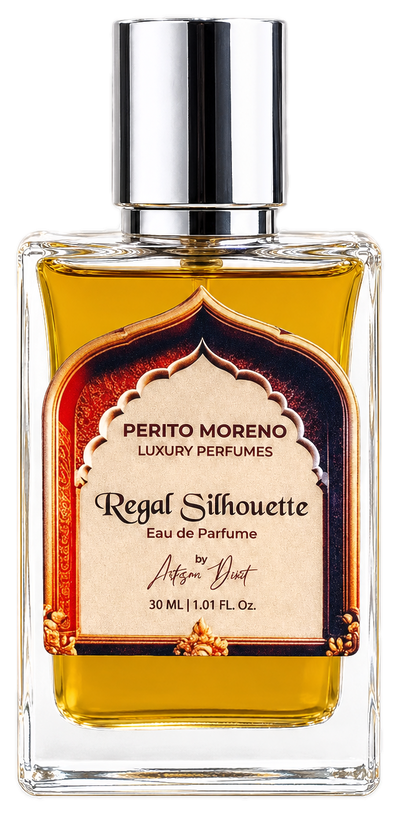
Regal Silhouette
A royal barber’s oils: herbs, spice, wood.

Meditation Swipe
Omani frankincense first, then rose.
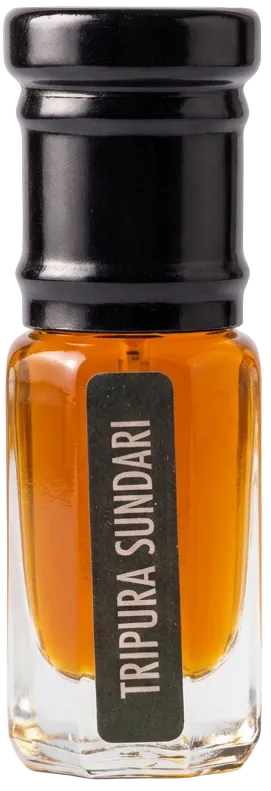
Tripura Sundari
An Offering to the Divine Feminine